









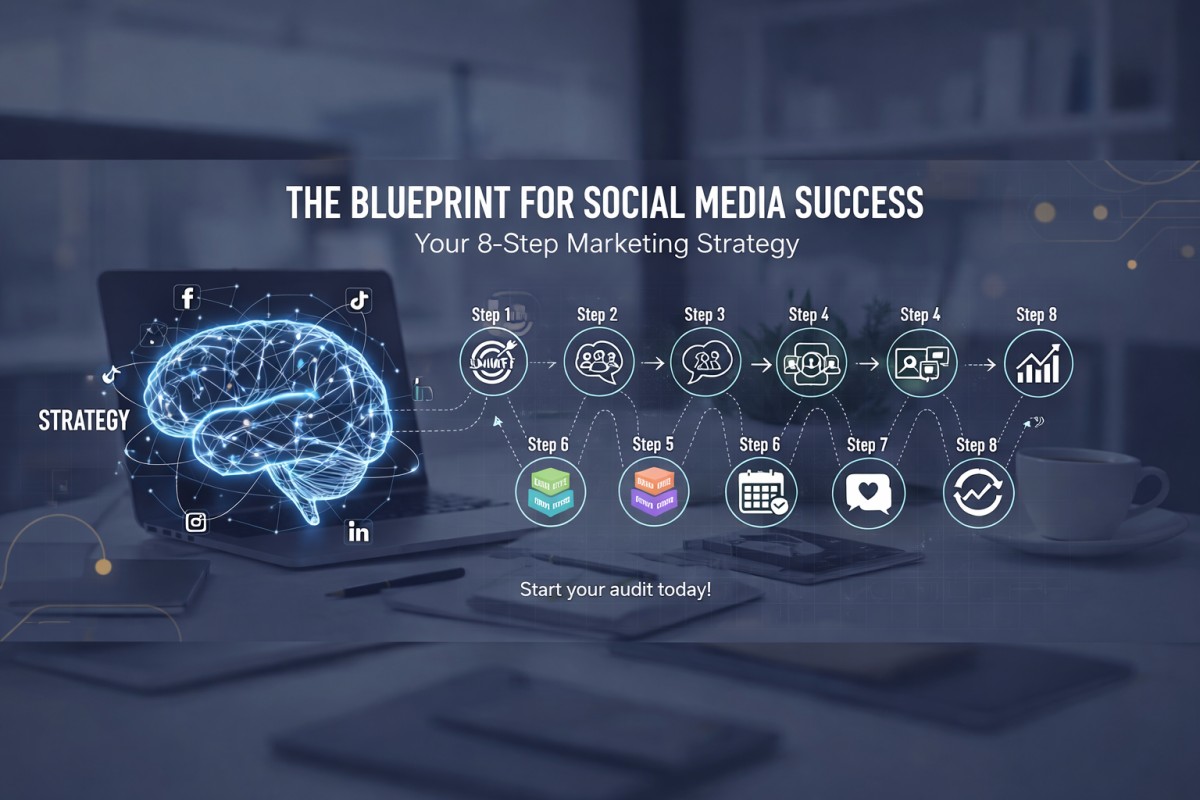
In today’s digital landscape, simply having social media profiles is not enough to drive business growth. The critical differentiator between noise and impact is a documented social media marketing strategy. Many businesses post content randomly without a coherent plan, which leads to wasted resources and minimal return on investment. Success is not accidental; it is engineered through a structured, intentional social media marketing strategy designed to deliver measurable outcomes.
Why a Social Media Marketing Strategy is Non-Negotiable
Without a strategy, you’re navigating without a map. A defined plan helps you:
- Focus your efforts on platforms and tactics that matter.
- Connect with the right audience in a meaningful way.
- Measure success and justify your investment (ROI).
- Stay consistent in messaging and branding.
- Adapt and improve based on data, not guesswork.
Let’s build your strategy, step-by-step.
Step 1: Audit and Analyze for Your Social Media Marketing Strategy
Start by taking stock of where you stand.
- Profile Assessment: Are your bios complete, branded, and keyword-optimized? Do all profile pictures and cover images align with your brand?
- Performance Analysis: Use native analytics (like Instagram Insights or Facebook Analytics) to identify your top-performing content. Which posts got the most engagement, clicks, or shares? What format (video, image, carousel) worked best?
- Competitor Analysis: Look at 3-5 competitors. What are they doing well? Where are the gaps you can fill? Note their engagement style and content mix.
This audit provides a baseline to understand what’s working and what needs change.
Step 2: Define SMART Goals for Your Social Media Marketing Strategy
Your goals must direct every action. Vague aims like “get more followers” are not enough. Use the SMART framework:
- Specific: Increase brand awareness among professionals aged 25-34.
- Measurable: Grow Instagram followers by 15% in Q3.
- Achievable: With your current resources, is this realistic?
- Relevant: Does this goal align with broader business objectives (e.g., launching a new product)?
- Time-bound: Achieve this within the next 90 days.
Example SMART goals: Generate 50 qualified leads per month via LinkedIn, increase website traffic from social by 25% in 6 months, or achieve a 5% average engagement rate on Facebook posts.
Step 3: Know Your Audience: The Foundation of Your Strategy
You can’t create compelling content if you don’t know who you’re talking to. Move beyond basic demographics.
- Create Audience Personas: Give your ideal customer a name, job role, challenges, and goals. Where do they spend time online? What content do they value? What problems can you solve for them?
- Use Social Listening: Tools like Brand24, Hootsuite, or even free platform searches can show you the conversations happening around your industry, brand, and keywords.
- Analyze Platform Demographics: Don’t waste time on platforms your audience doesn’t use. For example, if targeting Gen Z, TikTok and Instagram Reels are crucial. For B2B, LinkedIn is paramount.
Step 4: Choose Platforms for Your Social Media Marketing Strategy
Go where your audience is, not where the trend is. It’s better to master 2-3 platforms than to have a weak presence on 6.
- Facebook: Broad demographics, excellent for communities (Groups), advertising, and longer-form content.
- Instagram: Visual storytelling, ideal for brands with strong aesthetics, Reels for reach, Stories for engagement.
- TikTok: Short-form, creative video for younger audiences; great for viral trends and authentic content.
- LinkedIn: B2B goldmine, professional networking, industry thought leadership, and recruitment.
- X (Twitter): Real-time news, customer service, and industry conversations.
- Pinterest: Visual search engine, ideal for lifestyle, DIY, fashion, and planning-related businesses.

Step 5: Develop Content Pillars Within Your Strategy
This is the heart of your plan. Content pillars are 3-5 broad topics that represent your brand’s value.
- Example for a Fitness Coach: Pillar 1: Educational (workout tips), Pillar 2: Inspirational (client success stories), Pillar 3: Behind-the-Scenes (coach’s routine), Pillar 4: Promotional (online course details).
- Content Mix: Follow the Rule of Thirds: 1/3 promotes your business, 1/3 shares ideas/stories from industry leaders, and 1/3 engages directly with your community.
- Content Formats: Diversify with images, short-form videos (Reels/TikTok), long-form videos (YouTube/IGTV), carousels (great for tutorials), stories (for urgency/engagement), and live videos.
Step 6: Create a Content Calendar to Execute Your Strategy
Consistency builds trust and algorithm favor.
- Planning: Use a tool like Trello, Asana, or a dedicated social media scheduler (Buffer, Later, Hootsuite) to plan your posts.
- Calendar Details: Include the date, time, platform, caption, visuals, hashtags, and link.
- Optimal Timing: Test post times, but generally, post when your audience is most active. Analytics will guide you.
Step 7: Engage, Don’t Just Broadcast: Activating Your Strategy
Social media is a two-way street. The “social” part is critical.
- Dedicate Time: Schedule 15-20 minutes, twice daily, solely for engagement.
- Actions: Respond to all comments and messages promptly. Comment meaningfully on other industry accounts’ posts. Ask questions in your captions and respond to answers. Run polls or Q&A sessions in Stories.
Step 8: Analyze and Optimize Your Social Media Marketing Strategy
A strategy is a living document. Regularly check your analytics against the SMART goals you set.
- Key Metrics (KPIs):
- Awareness: Reach, Impressions, Follower Growth.
- Engagement: Likes, Comments, Shares, Saves, Engagement Rate.
- Conversion: Click-Through Rate (CTR), Leads Generated, Conversion Rate, ROI.
- Monthly Reviews: What content performed best? Which goals were met? Where did you fall short? Use these insights to refine your next month’s plan.
Conclusion: The Blueprint for Success
Creating a social media marketing strategy that works is a deliberate process, not a one-time task. It begins with deep self-audit and audience understanding, is driven by SMART goals, fueled by valuable content, and perfected through consistent engagement and analysis. By following this framework, you move from sporadic, ineffective posting to becoming a strategic, results-driven brand on social media. Remember, the goal isn’t to be perfect from day one, but to be purposeful and data-informed. Start building your strategy today, and transform your social media channels into powerful engines for business growth.
Ready to put your strategy into action? Begin with Step 1—conduct your social media audit this week, and you’ll already be ahead of the competition.