









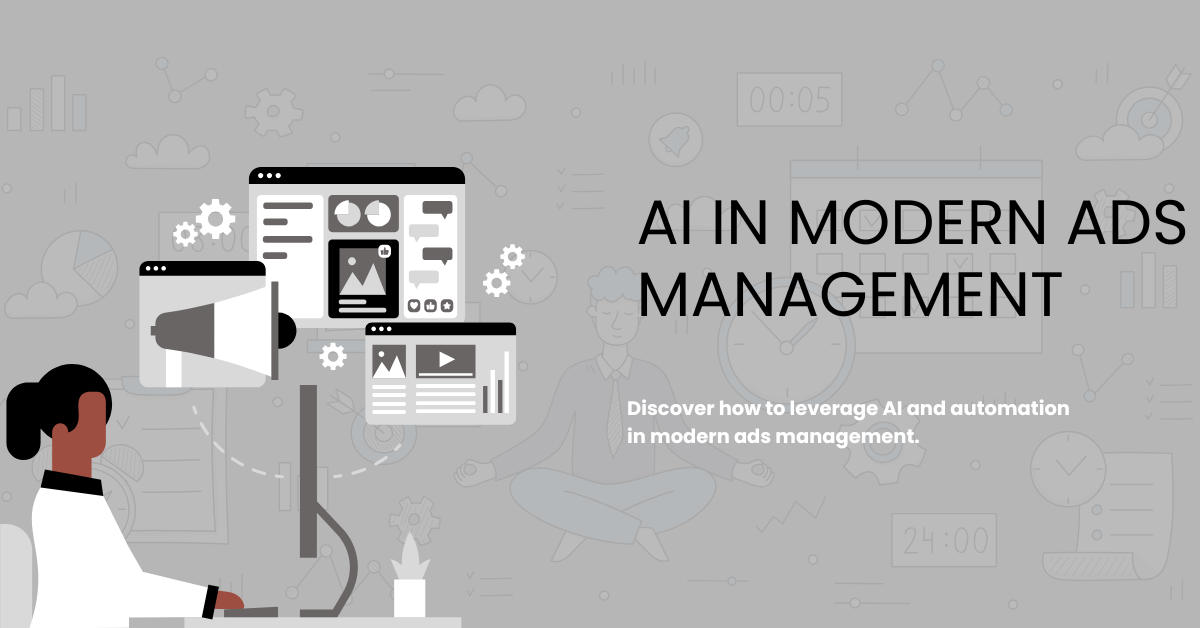
The digital advertising landscape has undergone a seismic shift. Gone are the days when managing ads meant manually adjusting bids in Excel, writing fifty variations of ad copy by hand, and praying that the targeting was right—a world entirely devoid of ads management automation. Welcome to the era of Modern Ads Management, where Automation and Artificial Intelligence (AI) are not just buzzwords—they are the engines driving profitability.
For business owners and marketing professionals, the question is no longer “Should I use AI?” but rather “How do I use automation and AI in modern ads management to beat my competition?”
This guide will walk you through the practical applications, tools, and strategies to leverage AI-powered ad automation effectively, ensuring your ad spend works harder and smarter.
Why Traditional Methods Fail Without Ads Management Automation
Before diving into the “how,” it’s crucial to understand the “why.” The modern consumer expects personalization. They move across devices—phone, tablet, desktop—and platforms—Instagram, Google, TikTok—seamlessly.
For a human, tracking this journey and adjusting bids in real-time is impossible.
- Data Overload: The average campaign generates thousands of data points daily.
- The Speed of Auctions: Programmatic ad auctions happen in milliseconds..
1. Smart Bidding: The Foundation of AI-Driven Ads Management Automation
The most accessible entry point into AI ads management is Automated Bidding.
Here is how to use automation in bidding:
- Target CPA (Cost Per Acquisition): Tell the AI your desired cost per sale. The algorithm analyzes historical data, user location, device, browser, and time of day to bid higher on users likely to convert and lower on those who aren’t.
- Target ROAS (Return on Ad Spend): This is for e-commerce. If you want a 500% return, the AI optimizes bids to find customers who are likely to spend more.
- Maximize Conversions: Use this when you have a strict budget but want the most volume. The AI spends your budget on the times it predicts the highest chance of a conversion.
2. Predictive Audiences and Lookalikes in Automated Ad Management
Meta’s and Google’s AI excels at pattern recognition. When you upload your customer list (CRM data), the AI doesn’t just find people with the same age or location; it finds people with the same online behavior.
How to implement this:
- Value-Based Lookalikes: Instead of creating a lookalike audience of your top 1% of customers, let the AI find people who look like your highest lifetime value customers.
- Predictive Audiences: On Meta, you can create audiences of people who are “Likely to purchase in the next 7 days” based on their past interactions with your app or site. This uses machine learning to prioritize “warm” traffic.
3. Creative Optimization and Dynamic Personalization
AI isn’t just about numbers; it’s about creativity. One of the biggest bottlenecks in ads management is creative fatigue—when audiences get bored of seeing the same ad.
Responsive Search Ads (RSAs):
Google’s RSAs allow you to input up to 15 headlines and 4 descriptions. The AI then tests thousands of combinations, learning which headline/description pairing performs best for specific search queries.
Dynamic Creative (Meta):
Meta’s Advantage+ Creative can automatically:
- Adjust brightness and contrast of images.
- Shift the orientation (1:1 to 4:5) to fit placements.
- Add movement to static images.
- Generate alternative ad copy variations.
4. Programmatic Advertising: The Next Level of Ads Management Automation
For businesses looking to scale beyond Google and Meta, Programmatic Advertising is the ultimate use of automation.
Programmatic platforms (like DV360 or The Trade Desk) use AI to buy ad inventory across millions of websites and apps in real-time. Instead of buying a banner ad on a specific sports website, you tell the AI:
“Find me a male user, aged 25-40, who recently researched running shoes, and show them my ad wherever they go on the web.”
5. Automating Rules for Efficiency
Sometimes, AI isn’t about predicting the future; it’s about automating the present. Most ad platforms and third-party tools (like Optmyzr or AdEspresso) allow you to set up automated rules.
Examples of “If/Then” Automation:
- Rule: If a keyword spends 2x the average CPA and has no conversions after 500 clicks, pause it.
- Rule: If a product’s ROAS drops below 300%, reduce the bid by 20% at midnight.
- Rule: If the budget is exhausted by the 20th of the month, increase the daily budget by 15% for the remaining days.
These rules ensure your campaigns are always “patrolling” for inefficiency, even when you’re asleep.
The Human Element: Strategy Over Tactics
With all this talk of AI, a common fear arises: Will robots replace ad managers?
The answer is no. But ad managers who use AI will replace those who don’t.
The role of the marketer shifts from being a “button pusher” to a “strategist.” Your new responsibilities in modern ads management include:
- Data Architecture: Ensuring tracking (pixels, APIs) is set up perfectly. Garbage in = Garbage out. If you feed the AI bad data, it makes bad decisions.
- Interpretation: The AI can tell you what happened (e.g., CPA increased). You need to figure out why (e.g., new competitor entered the market, website speed dropped).
- Creative Direction: AI cannot (yet) truly understand human emotion, humor, or cultural nuance.
Best Practices for Implementation
To successfully use automation and AI in your ads management, follow this checklist:
- Start with Conversion Tracking: Ensure your Google Tag Manager and Meta Pixel are firing accurately. Implement server-side tracking to combat data loss from ad blockers.
- Give the AI Time: Machine learning models have a “learning phase.” If you change your bids or creative every 2 hours, the algorithm never stabilizes. Let campaigns run for at least 7-14 days before judging performance.
- Consolidate Data: Use tools like Zapier or manual uploads to feed CRM data (like customer upgrades or churn) back into the ad platforms. This tells the AI who not to target.
- Don’t Fully Automate Everything: Keep a portion of your budget (say 10-20%) for experimental, manually controlled campaigns to test new angles that the “safe” AI might avoid.
Conclusion
The shift to AI-driven ads management is not a trend; it is the new operating system of digital marketing. By embracing smart bidding, predictive audiences, dynamic creative, and automated rules, businesses can achieve a scale and efficiency previously reserved for Fortune 500 companies.
The future belongs to marketers who can harness the power of machines while steering the ship with human empathy and strategic insight. Start small, trust the data, and let the algorithms handle the math so you can focus on the message.