









Scaling Facebook ads in 2026 looks nothing like it did five years ago. Effective Facebook ads management has evolved beyond simply increasing a budget and watching profits multiply. With the rollout of Meta Lattice, the Andromeda update, and the dominance of Advantage+ campaigns, the platform’s AI now controls the majority of delivery and optimization decisions.
For media buyers and business owners, this creates a new paradox in Facebook ads management: you scale by letting go, but you win by feeding the machine better data. If you try to micromanage audiences or constantly tweak settings under an outdated Facebook ads management approach, you actively harm your campaign performance.
This guide provides a modern, step-by-step playbook for scaling campaigns in 2026. We will move from foundational setup to advanced budget pacing, ensuring you scale revenue without scaling your cost-per-acquisition (CPA)—all while mastering the nuances of contemporary Facebook ads management.
Step 1: Audit Your Signal Foundation (The Pre-Scale Check)
Before you even think about increasing a budget, you must audit the quality of the data you are sending to Meta. In 2026, the competition isn’t creative polish or bidding strategy—it is signal quality .
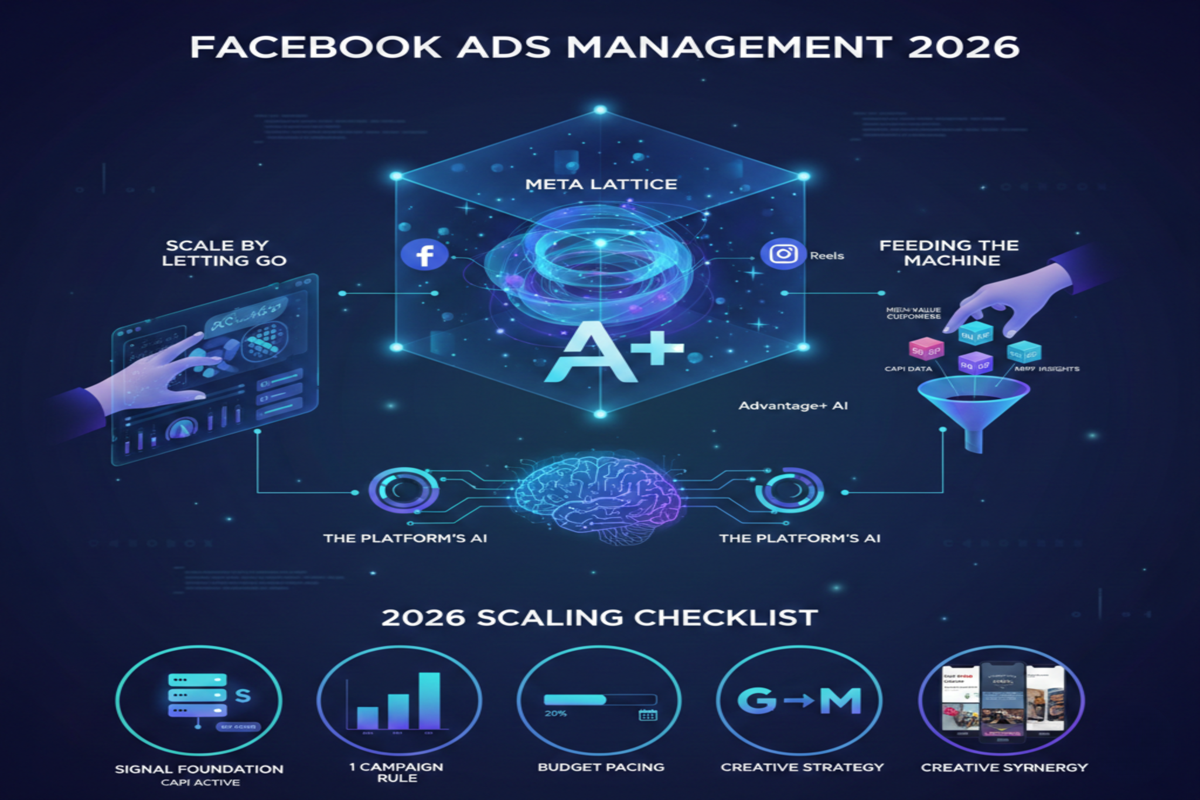
The Meta Lattice update collapses ad delivery across Facebook, Instagram, and Reels into a single learning system. This system learns faster than most advertisers adapt, but it relies on accurate inputs. If your tracking is broken, scaling will only magnify your losses .
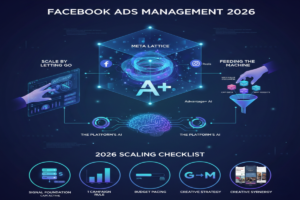
Your 2026 Scaling Checklist:
- Implement CAPI (Conversions API): Relying solely on the pixel leaves money on the table due to browser restrictions. Server-side tracking ensures you capture every conversion event .
- Define “High Value”: Don’t just track “Purchases.” Segment your first-party data. Upload lists of high-value customers separately from discount-seekers. This tells the algorithm who to find more of .
- Use MMPs for Apps: If you are running app campaigns, integrate a Mobile Measurement Partner (MMP) like Adjust or AppsFlyer to feed retention and LTV data back into Meta .
Key Insight: Brands that win in 2026 don’t out-optimize the algorithm; they out-inform it .
Step 2: Consolidate Structure (The “One Campaign” Rule)
The most common mistake when trying to scale is over-segmentation. Many advertisers still create separate campaigns for different audiences, hoping to manually control where money goes. In 2026, this approach starves the algorithm of data.
The Playbook: Consolidate your budget into one Campaign Budget Optimization (CBO) campaign per business objective .
Why this works:
- Data Consolidation: Meta’s AI needs 50+ conversions per week to exit the learning phase. A single campaign pools conversion data, helping the AI exit the learning phase faster .
- Flexibility: The Andromeda update allows the system to match the right creative to the right person instantly. You don’t need separate ad sets for different demographics if your creative speaks to them effectively .
Instead of launching ten new campaigns to scale, simply click “edit” on your winning CBO campaign’s daily budget. However, resist the urge to make drastic jumps.
Step 3: The 20% Rule in Facebook Ad Management
Once your structure is clean and your tracking is solid, scaling becomes a mechanical process of budget pacing. However, the way you increase budget determines whether your CPA stays stable or explodes.
The 20% Rule:
When you increase a budget, never jump more than 20% at a time. Larger shocks reset the learning phase, causing the algorithm to re-explore who to show ads to, which temporarily increases CPA .
The 4-Day Wait Rule:
After increasing a budget, performance often dips for a day or two as the algorithm expands its reach. Novice media buyers panic and pull back. Experts wait.
- Days 1-3: Hold steady. The algorithm is rebalancing.
- Day 4: Evaluate. If performance has not returned to baseline, consider scaling back by 20% .
The “Hard Deck” Concept: Always maintain a minimum spend floor (e.g., $2,000/day) even during performance lulls. Dropping to zero kills the data flow needed to test new creatives .
Step 4: Feeding the Machine Through Facebook Ad Management
With automation handling targeting, your creative is now your only true targeting lever. The Andromeda engine thrives on variation and volume, not single “winning” ads .
Creative Strategy for 2026:
- Persona-Led Creatives: Move beyond demographics. Use psychological profiles. For example, appeal to “Sensing” personalities with detailed product USPs, and “Feeling” personalities with storytelling and community .
- Authenticity Over Polish: In 2026, “raw” and “unfiltered” content (UGC-style videos, “yap” videos) often outperforms highly produced corporate ads. Users are weary of AI-generated perfection .
- Vertical-First (9:16): With 90% of inventory being vertical, ensure every asset is optimized for mobile viewing .
Dynamic Creative Optimization (DCO):
Don’t just test one image vs. another. Use Meta’s dynamic creative tools to test combinations of up to 5 headlines, 5 primary texts, and 5 descriptions.
Step 5: Bid Strategy for Advanced Facebook Ad Managemen
Your bid strategy dictates how your budget is spent. Using the wrong one at the wrong time prevents scaling.
- Start with Highest Volume (Lowest Cost): When scaling into new audiences, use Highest Volume. This tells Meta to spend your budget and get the most results possible. It is the best way to gather initial data .
- Switch to ROAS Goal or Cost Cap: Once you have historical data (2-4 weeks), you can switch to a ROAS Goal or Cost Per Result Goal. This locks in profitability by telling Meta, “Don’t spend if you can’t hit this target” .
Step 6: Cross-Channel Synergy in Facebook Ad Management
One of the most powerful scaling tactics for 2026 is Signal Unification. This involves breaking down the silos between your Google Ads and Meta Ads data .
The Tactic:
- Capture high-intent users on Google Search (e.g., users searching for “premium running shoes”).
- Use this intent data to create a Cross-Channel Remarketing audience on Meta.
- Serve these users highly relevant visual ads on Instagram or Facebook.
Summary: The 2026 Scaling Checklist
To successfully scale Facebook ads this year, follow this weekly rhythm:
- Pre-Flight Check: Ensure CAPI is active and conversion tracking is clean .
- Structure: Consolidate spending into 1-2 CBO campaigns per objective .
- Creative: Launch 3-5 new creative variations weekly. Think in systems, not one-offs .
- Budget Pacing: Adjust budgets by 20% every 3-4 days based on performance trends .
- Analysis: Look at yesterday’s data. Did you hit your KPI? If yes, increase by 20%. If no, wait .