









In the crowded landscape of social media, where millions of posts compete for a split second of attention, brand voice has emerged as the ultimate differentiator. As you scroll through your feeds, you might notice a troubling phenomenon: everything is starting to sound the same. “If you go to the comment section of any viral post right now, all the brands are commenting and they all sound exactly the same,” observes Rachel Karten, a social media consultant .
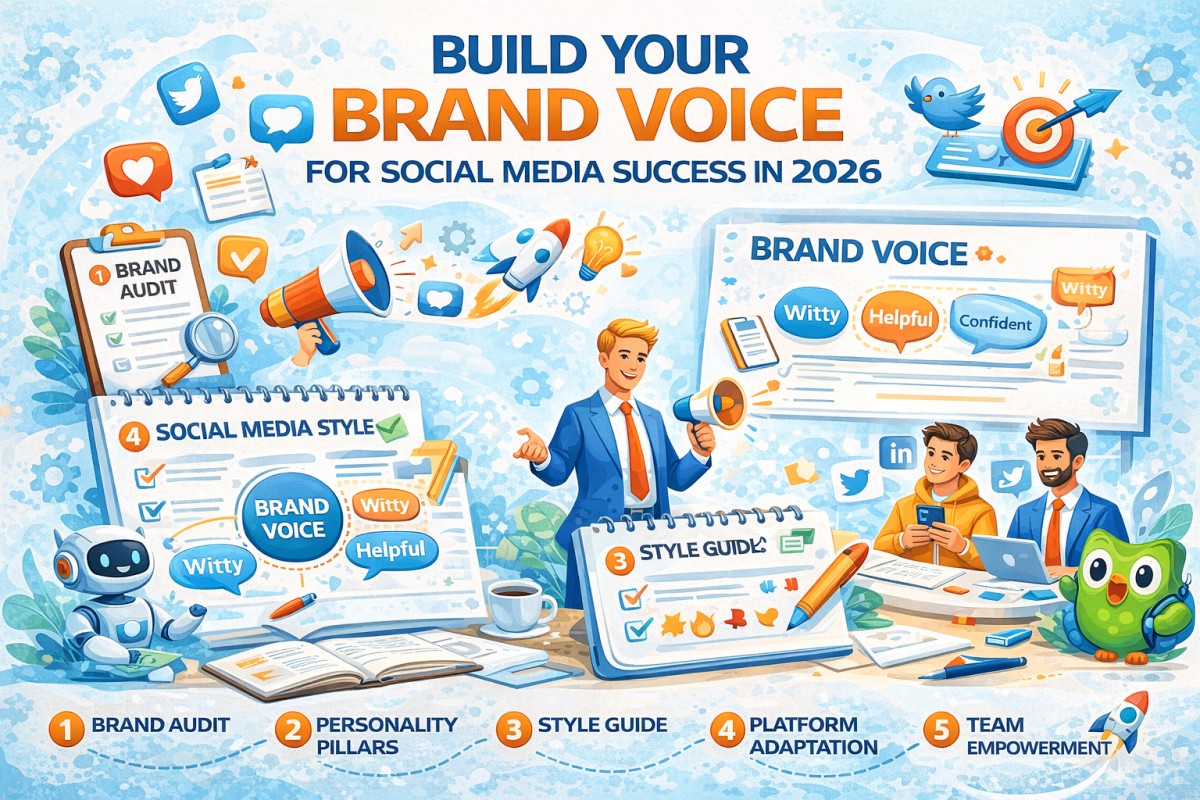
If you want your business to cut through the noise, you cannot afford to blend in. Building a distinctive brand voice for your social media marketing. Here is your step-by-step guide to building a brand voice that converts casual scrollers into loyal communities.
What is Brand Voice (And Why Does It Matter in 2026)?
Before diving into the “how,” we must define the “what.” Brand voice is the consistent personality and emotion your company expresses across all communications. It’s not just what you say, but how you say it .
It is crucial to distinguish voice from tone. While your voice remains constant (e.g., “helpful and witty”), your tone can shift depending on the context. You might use a serious tone when addressing a customer service issue, but a playful tone when launching a new product .
Step 1: Conduct a Brand Audit (Know Thyself)
You cannot know where you’re going until you know where you stand. Karen Freberg, a professor of strategic communications, emphasizes that brands need to start with a fundamental audit .
Ask yourself the hard questions:
- If your brand were a person, who would they be? Are they a sarcastic friend, a wise mentor, or an energetic coach?
- What are your brand’s core values?
- How do you currently communicate? Look at your top-performing posts from the last six months. What language do they share?
- How do your competitors sound?
Step 2: Define Your Brand’s Personality Pillars
Once the audit is complete, distill your findings into a concrete framework. Agencies like Fonzie use a “Verbal Identity” framework that translates values into a living system . A practical way to do this is to define 3-5 personality attributes.
For example:
- Nike: Inspirational, Motivational, Pushy .
- Liquid Death: Aggressive, Irreverent, Metal .
- Reformation: Conversational, Confident, Witty (e.g., their famous tagline: “Thanks, it’s Reformation”) .
Write these adjectives down. They become your north star for every caption, reply, and video script.
Step 3: Create a “Living” Social Media Style Guide
Gone are the days of dusty 50-page PDFs that no one reads. Today’s social media style guide needs to be a modular, accessible “micro-guide” that creators can use on the fly .
Your guide should include:
- Grammar & Mechanics: Are you using Oxford commas? Do you capitalize every word in a headline, or do you prefer sentence case? Some brands, like Domino’s, deliberately use all lowercase to mimic the style of younger customers .
- The Emoji Palette: Not every emoji is for every brand. Limit your team to 3-5 core emojis that fit your personality (e.g., Liquid Death might use , while a travel brand might use) .
- The “Do Not” List: This is just as important as the “Do” list. What words or phrases are banned? If you’re an irreverent brand, banning corporate jargon like “synergy” or “circle back” is a good start.
- Hook Architecture: Supply your content creators with tested hook formulas. For example: Tension, Anchor, Benefit (“You’re wasting half your serum every morning. Here’s what dermatologists do instead.
Step 4: Adapting Your Brand Voice Across Platforms
A common mistake is using the exact same language on LinkedIn that you use on TikTok. They are different ecosystems with different audience expectations.
- TikTok & Reels: These platforms reward conversational pacing, quick hooks, and native cadence. The goal is to weave your “brand lexicon” into the platform’s rhythm. Duolingo excels at this by marrying fast-paced trends with their unique “owl chaos” humor .
- X (Twitter): This is often the home of real-time cultural commentary and customer service. It requires wit and brevity.
- LinkedIn: Usually requires a more professional, educational, or inspirational tone, though even this is loosening up.

Step 5: Trusting Your Team to Uphold the Brand Voice
One of the biggest lessons from viral sensations like Duolingo is the power of autonomy. Duolingo’s social media team is given the freedom to react to trends in real-time without endless layers of approval .
“If you just jump in all at once, that’s culture shock,” Freberg notes, referencing McDonald’s early Twitter days. But by trusting specialists, you can move from being a follower to a shaper of culture .
Case Studies: Brand Voice in Action
Sometimes, the best way to learn is to look at those getting it right.
The Rebel: Duolingo
Duolingo turned a green owl into a global menace. They leaned into user jokes about being spammed by the app, creating a persona that is “unfiltered, irreverent, and self-aware.” Their “Death of Duo” campaign generated over 1.7 billion impressions, proving that even “annoyance” can be a powerful brand asset when tied to a consistent voice .
The Comeback Kid: Yahoo
In 2024, Yahoo wiped its social channels clean and reintroduced itself with a simple “Hello” and its iconic yodel. The CMO, Josh Line, focused on modernizing the brand’s “funny, wacky, self-aware sense of humor” without losing its roots.
The Sensory Strategist: Magnum
Magnum realized that in a sea of visual clutter, audio could be the differentiator. They bet on the distinctive “Magnum crack” as their signature sound. Using spatial audio and ASMR techniques on Meta platforms (where 93% of Reels are viewed with sound on), they achieved an action intent rate six times higher than the CPG benchmark .