







In the B2B marketing landscape, LinkedIn stands as the undisputed king of organic and paid reach. With over 1 billion members, it’s the only major platform where decision-makers scroll with a professional intent to learn, network, and solve business problems. However, LinkedIn Ads management for lead generation is notoriously tricky. It’s often perceived as expensive, and without a sharp strategy, budgets can vanish with little to show in return.
Gone are the days of simply boosting a company page post and hoping for the best. Modern Linkedin Ads management requires a surgical approach: combining the platform’s granular targeting with a deep understanding of human psychology and funnel stages. This article outlines the definitive strategies to transform your ad spend into a predictable B2B lead generation engine in 2026.
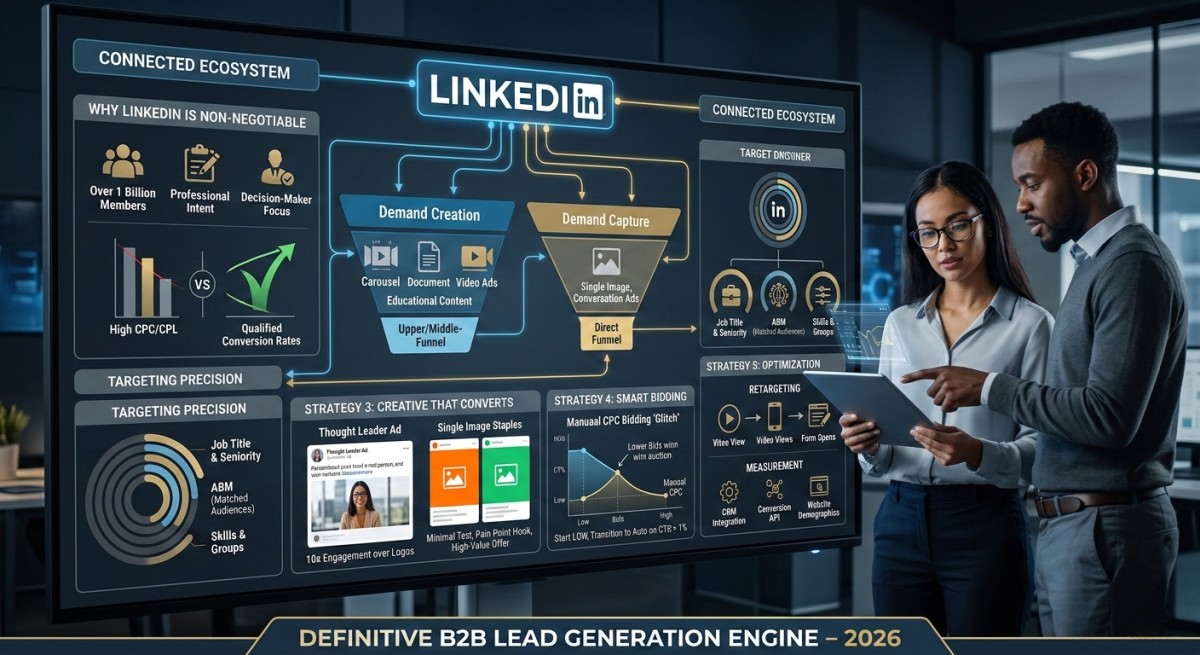
Why LinkedIn is Non-Negotiable for B2B Lead Generation
Before diving into tactics, it’s crucial to understand why LinkedIn commands a premium. You aren’t just paying for impressions; you are paying for context.
This unique environment allows for precision targeting simply not available elsewhere:
- Job Title & Seniority: Reach the C-Suite or specific heads of departments.
- Account-Based Marketing (ABM): Target specific companies by name using Matched Audiences .
- Skills & Groups: Home in on prospects with specific expertise .
Strategy 1: Mastering the Full-Funnel Approach in LinkedIn Ad Management
The biggest mistake B2B marketers make is treating LinkedIn like Google Ads. Google captures demand from people actively searching for a solution. LinkedIn is for creating demand for the other 98% of your audience who aren’t yet in the market .
To manage this effectively, you must segment your strategy into two distinct lanes:
1. Bottom-of-Funnel (Demand Capture)
This targets the small percentage (2-3%) of your ICP that is actively evaluating solutions. Here, direct response works.
- Tactic: Use Single Image Ads or Conversation Ads with clear CTAs like “Request a Demo” or “Start Free Trial.”
- Format: LinkedIn Lead Gen Forms are ideal here. They auto-fill with user profile data, reducing friction and increasing conversion rates .
2. Middle-of-Funnel (Demand Creation)
For the vast majority who don’t know you, you need to act as a “content strategist,” not a “performance marketer” .
- Tactic: Serve educational content that builds trust. Think industry benchmarks, executive guides, or problem-focused webinars.
- Format: Carousel Ads, Document Ads, and Video Ads work well to explain complex problems and solutions without a hard sell .
Strategy 2: Hyper-Personalized Targeting in Your LinkedIn Ads Management
Effective LinkedIn Ads management relies on structure. Avoid building campaigns around specific assets; instead, build them around audiences .
The Four Reliable Paths
To build a robust Ideal Customer Profile (ICP), combine these targeting layers:
- Job Titles: The most direct path.
- Job Function + Seniority: Casts a wider net but remains relevant (e.g., “Function: IT” + “Seniority: Director”).
- Skills + Seniority: Excellent for niche roles (e.g., “Skill: Kubernetes” + “Seniority: Senior”).
- Group Membership: Targets users interested in specific professional communities .

Strategy 3: Creative That Converts in 2026
In the feed, you have milliseconds to stop the scroll. Your creative needs to be a pattern interrupt.
The Rise of Thought Leader Ads (TLAs)
The highest-performing ad format on LinkedIn right now is Thought Leader Ads. These are organic posts from your employees (not the company page) that you amplify with ad spend.
- Why they work: People trust people, not logos. Personal profiles get 10x more engagement than company pages .
- Execution: Have your CEO or subject matter expert post a personal insight, story, or hot take. Then, sponsor that post to your ICP.
Why Single Image Remains a Staple of LinkedIn Ad Management
While video is growing, single-image ads remain the workhorse, comprising roughly 80% of high-performing media .
- Visuals: Use contrasting colors (oranges and greens stand out against LinkedIn’s blue/gray interface) .
- Copy: Think “headline, not paragraph.” Keep image text minimal. The hook should be a clear benefit or a painful problem .
- The Offer: Don’t lead with “Schedule a Demo” to cold traffic. Use low-friction, high-value offers like checklists, worksheets, or benchmark reports. You need to warm them up first .
Strategy 4: Smart Bidding and Budget Management
LinkedIn’s default settings are designed to spend your money quickly. Smart managers know how to hack the system.
The Manual CPC “Glitch” in LinkedIn Ad Management
Always start with Manual Cost Per Click (CPC) bidding. LinkedIn’s default is “Maximum Delivery,” which is the most expensive way to buy traffic .
- Switch to auto-bidding (Maximum Delivery) only once your Click-Through Rate (CTR) exceeds 1% , signaling that the algorithm knows your winning formula .
Frequency and Saturation
Monitor your frequency closely. B2B decisions require multiple touches.
- The “2-Ad Rule”: If a campaign contains two or fewer ads, LinkedIn will show each only once every 24 hours per user.
Strategy 5: Retargeting and Multi-Touch Attribution
The “set it and forget it” mentality is the enemy of ROI.
Smart Retargeting
LinkedIn’s Insight Tag allows for powerful native retargeting. Don’t just retarget website visitors; retarget based on engagement :
- Video Views: Retarget users who watched 50% of your video with a deeper case study.
- Lead Form Opens: If someone opened your lead gen form but didn’t submit, send them a different message addressing potential objections.
- Company Page Visits: Retarget companies that are checking you out.
Integrating and Measuring Your LinkedIn Ads Management Efforts
To prove ROI, you must connect LinkedIn to your CRM.
- Use UTM parameters on every ad to track performance in Google Analytics .
- Implement the LinkedIn Conversion API to track offline conversions (like closed deals) back to the ad that influenced them .
- Use Website Demographics to see which companies and job functions are visiting your site after clicking your ads, validating your targeting assumptions .
Conclusion: The 2026 Mindset
LinkedIn Ads management for B2B lead generation is no longer just about running ads; it’s about building a connected ecosystem. It requires the patience to nurture the 98% who aren’t ready to buy, the courage to let your employees be the face of the brand, and the technical savvy to outsmart the bidding algorithms.
By moving away from siloed campaigns and toward a **connected system—where Google captures intent, LinkedIn qualifies buyers, and Meta scales the message—you turn LinkedIn from a cost center into a profit center .