









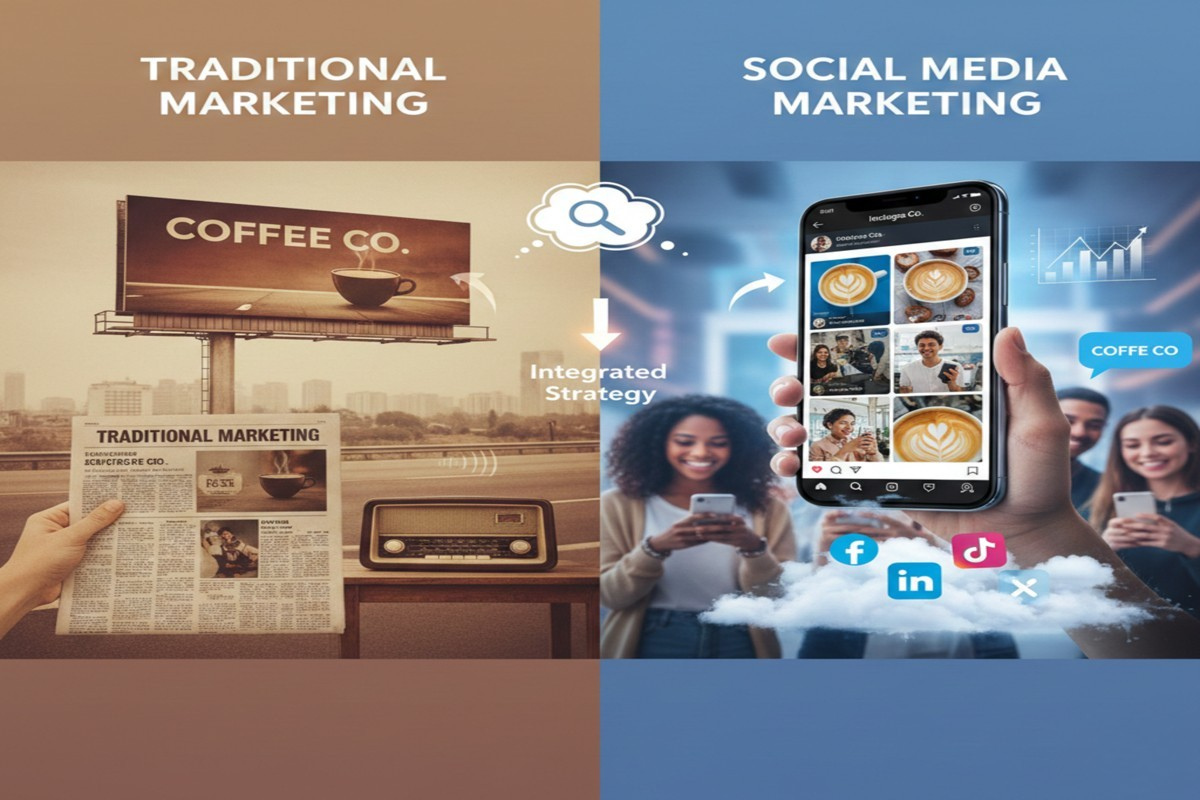
In the ever-evolving world of business, getting your message in front of the right audience is the ultimate goal. For decades, the playbook was simple: buy a TV spot, a radio ad, or a billboard. However, the digital age has rewritten the rules, placing powerful social media platforms directly into the hands of consumers and businesses alike. Today, marketers face a crucial choice: Social Media Marketing or Traditional Marketing?
Understanding the nuances of each is no longer just an option—it’s a necessity. This article dives deep into the key differences and benefits of social media marketing versus traditional marketing, helping you decide how to allocate your budget for maximum impact .
What is Social Media Marketing?
Social Media Marketing (SMM) is a form of digital marketing that leverages social networks to connect with an audience, build a brand, increase sales, and drive website traffic. This involves publishing engaging content, listening to followers, running targeted ads, and analyzing analytics .
Common platforms include:
- Facebook, Instagram, and TikTok: Ideal for visual storytelling and reaching broad demographics.
- LinkedIn: The go-to platform for B2B marketing and professional networking.
- X (Twitter): Used for real-time news, customer service, and community engagement .
Unlike traditional methods, SMM thrives on two-way communication. It allows for conversations, user-generated content, and real-time feedback, turning customers into active participants in the brand story .
What is Traditional Marketing?
Traditional marketing refers to any form of marketing that promotes products or services through offline channels. It is the “old school” method of broadcasting a message to the masses. Before the internet, this was the only game in town .
Common channels include:
- Print: Newspapers, magazines, brochures, and billboards.
- Broadcast: Television and radio commercials.
- Direct Mail: Catalogs, postcards, and flyers sent to physical addresses.
- Outdoor: Billboards, transit ads, and posters .
The primary characteristic of traditional marketing is one-way communication. The business speaks, and the audience listens. There is no “reply” button on a billboard. This model is excellent for building broad brand awareness but offers little in terms of immediate feedback or interaction .
Key Differences Between Social Media Marketing and Traditional Marketing
While both aim to capture attention and drive sales, the mechanisms they use are vastly different. Here are the seven key areas where they diverge .
1. Communication: Monologue vs. Dialogue
- Traditional Marketing is a monologue. A TV commercial airs, and the message is delivered with no immediate way for the viewer to respond.
- Social Media Marketing is a dialogue. Brands post content, and users can instantly like, comment, or share. This interaction builds community and trust .
2. Reach: Spray and Pray vs. Precision Targeting
- Traditional Marketing casts a wide net. A billboard might be seen by thousands of drivers, but only a fraction are potential customers. It relies on high volume to catch a few relevant eyes.
- Social Media Marketing uses algorithms to deliver content specifically to users based on demographics, interests, behaviors, and location. This precision reduces waste and increases the chances of conversion .
3. Cost: High Budgets vs. Scalable Spending
- Traditional Marketing often requires significant upfront investment. Producing a high-quality TV commercial and buying airtime can cost tens of thousands of dollars, putting it out of reach for many small businesses .
- Social Media Marketing is highly cost-efficient. You can start with a small budget on Facebook or Instagram ads and scale up as you see positive returns. Organic posts (non-paid) are free, making it accessible for businesses of any size .
4. Measurability: Gut Feeling vs. Hard Data
- Traditional Marketing is difficult to measure. While you can estimate the readership of a magazine, it’s nearly impossible to know exactly how many people bought a product because of that specific ad .
- Social Media Marketing provides real-time analytics. You can see exactly how many people viewed, clicked, and converted from an ad. This data allows for constant optimization and a clear calculation of Return on Investment (ROI) .
5. Flexibility: Set in Stone vs. Real-Time Adaptation
- Traditional Marketing is rigid. Once a print ad goes to the publisher or a radio spot airs, it cannot be changed without incurring major costs.
- Social Media Marketing is highly flexible. If a post isn’t performing well, you can pause it, change the image, adjust the copy, or target a different audience within minutes .
6. Content Format: Static vs. Dynamic
- Traditional Marketing relies on static formats like a 30-second spot or a magazine photo.
- Social Media Marketing embraces a variety of dynamic formats including short-form video (TikTok/Reels), live streams, stories, infographics, and interactive polls. This variety keeps content fresh and engaging .
7. Longevity: Ephemeral vs. Evergreen
- Traditional Marketing has a defined lifespan. A newspaper ad dies at the end of the day.
- Social Media Marketing can have an extended life. While a single post may disappear from a feed quickly, high-quality “evergreen” content (like a blog post or YouTube video) can be found and drive traffic for months or even years, especially when combined with SEO strategies .
Benefits of Each Approach
Despite their differences, both marketing schools offer unique advantages.
Benefits of Traditional Marketing
- Credibility and Trust: Established brands often gain trust by appearing in reputable newspapers or on prime-time TV. The physical presence of a billboard or magazine ad can lend an air of legitimacy and permanence that digital ads sometimes lack .
- Broad Local Reach: For businesses targeting a local demographic (e.g., a new restaurant or a local car wash), radio spots or local newspaper ads can be highly effective at reaching the entire community at once .
- Tangibility: Direct mail, like a well-designed catalog, provides a physical touchpoint that can be kept on a coffee table, offering repeated exposure that a digital ad cannot match .
Benefits of Social Media Marketing
- Building Relationships: SMM allows brands to humanize themselves. By responding to comments and messages, brands can build loyalty and turn customers into advocates .
- Viral Potential: A single piece of great content can be shared thousands of times, achieving exponential reach that would cost a fortune in traditional media .
- SEO Synergy: Social media activity can indirectly boost your search engine rankings. Content shared on social media generates visibility, which can lead to more backlinks and website traffic—a key signal for Google’s algorithm .
Finding the Right Balance: An Integrated Approach
So, which is better? The answer is rarely one or the other. The most successful modern marketing strategies are often integrated, leveraging the strengths of both worlds .
- Use Social Media to Listen: Pay attention to conversations on social media to understand what your customers care about. What questions are they asking? What problems do they have?
- Inform Traditional Campaigns: Use those insights to craft a traditional marketing campaign (like a TV or billboard ad) that speaks directly to those needs and desires.
- Drive Traffic to Digital: A billboard or TV ad is excellent for driving top-of-mind awareness, but the call-to-action should often lead to a digital space—a website, a social media profile, or a targeted landing page—where the conversion happens .
For example, a brand might use a traditional billboard (like the iconic McDonald’s “Follow the Arches” campaign) to capture attention, while using Instagram ads to retarget users who searched for nearby restaurants on their phones . Similarly, a deep-dive blog post optimized for SEO can be repurposed into a series of engaging TikTok videos, driving traffic back to the site .
Conclusion
The landscape of marketing is not a battleground where digital and traditional fight for supremacy; rather, it is a diverse ecosystem where both can thrive. Traditional marketing offers the power of broad reach and tangible credibility, while social media marketing provides precision targeting, real-time engagement, and detailed analytics .
For today’s businesses, the smartest strategy is to stop asking “Which one?” and start asking “How can they work together?” By understanding the key differences and benefits of each, you can craft a holistic marketing strategy that delivers the right message, to the right person, at the right time—whether they are scrolling through a feed or driving past a billboard.