









The digital advertising landscape of 2026 is no longer just about who spends the most; it is about who operates with the most intelligence. As consumer attention fragments across Connected TV (CTV), social platforms, and search engines, and as privacy regulations tighten, the need for a cohesive, strategic framework has never been more critical. Gone are the days of “spray and pray.” Today, effective digital ad management relies on a blend of clean data, human-centric creativity, and the strategic deployment of Artificial Intelligence (AI).
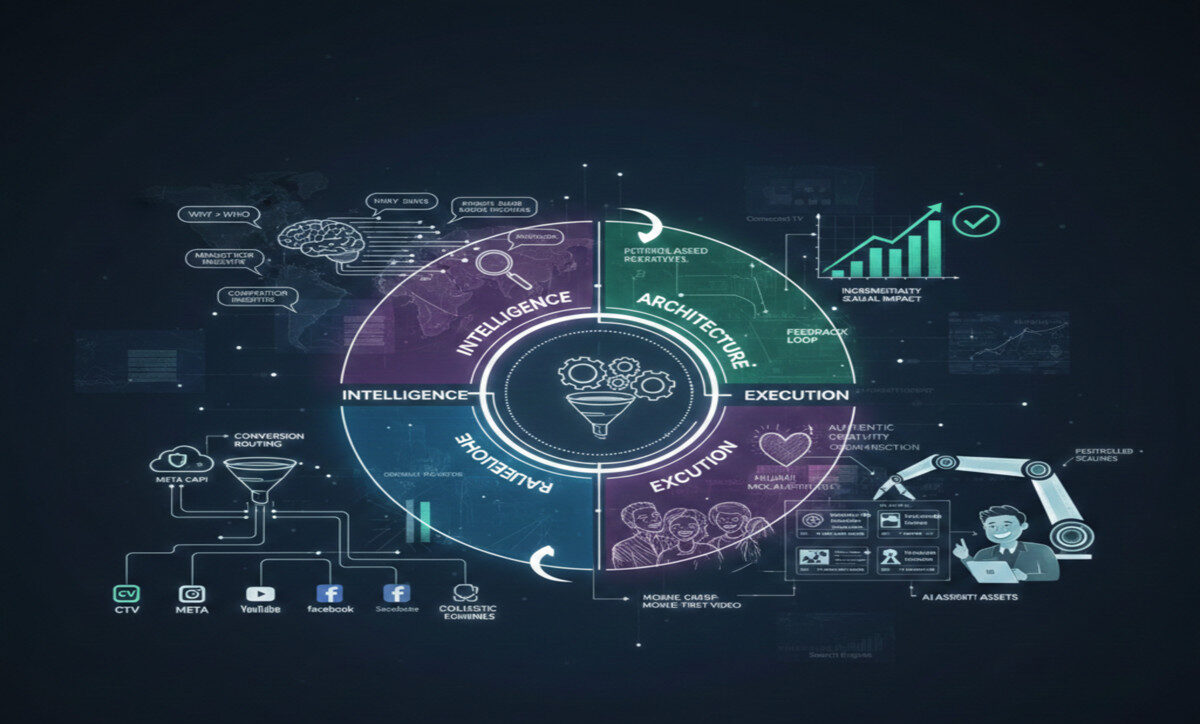
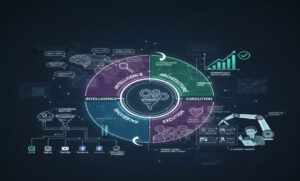
This article presents the ultimate framework for managing digital ads in 2026, structured around a continuous cycle of intelligence, architecture, execution, and analysis.
Phase 1: Building Your Digital Ad Management Foundation with Intelligence and Intent
Before launching a single campaign, modern advertisers must shift their focus from broad demographics to verified intent. The most successful frameworks in 2026 start not with the “who,” but with the “why.”
Leveraging Market Intel for Smarter Ad Management
Most campaigns fail because they skip the groundwork. Effective management begins with a rigorous analysis of the market landscape. This involves defining the target persona beyond basic age and gender, focusing instead on their beliefs, pain points, and customer journey stage—whether they are problem-aware or solution-aware . Utilizing tools like the Meta Ad Library to spy on competitors provides strategic intelligence on what creative angles and offers are currently dominating the space .
Shifting from Demographics to Mindset in Campaign Management
The industry is rapidly moving away from static audience definitions. In 2026, mindset replaces demographics as the primary planning signal. Advertisers are prioritizing emotional and situational context—understanding how the audience feels in the moment they encounter an ad . This shift is driven by the need to connect with consumers based on intent rather than relying on eroding third-party data cookies .
The Architecture of Modern Digital Ad Management
With a strategy rooted in intent, the next phase involves building a technical and structural foundation that allows for precision targeting and seamless measurement.
How Clean Data Optimizes Your Digital Ad Management
Data is the fuel that powers the AI systems of Google and Meta. In 2026, businesses with the cleanest, most accurate first-party data will have a significant competitive advantage . This means moving beyond basic pixels. Advertisers must implement robust conversion tracking using tools like the Meta Pixel alongside Conversion API (CAPI) gateways to ensure server-to-server data reliability despite browser restrictions . For performance goals like CPA and ROAS, it is best practice to define conversion events based on the user action closest to the actual sale (e.g., a purchase confirmation page rather than a homepage visit) .
Holistic Channel Pairing
There is no one-size-fits-all media mix. Research indicates that high-performing campaigns tailor their channel combinations to specific goals. For example, pairing the broad reach of TV with the engagement of YouTube builds awareness, while combining Facebook with in-store promotions drives localized action . Effective digital ad management in 2026 requires a holistic approach, understanding how channels like CTV and social media work together to create exponential results rather than operating in silos .
Phase 3: The Execution – Authentic Creativity Meets AI
Execution is where strategy becomes tangible. The framework for 202 balances the efficiency of AI with the irreplaceable value of human emotion.
The Creative Concept and Authenticity
As AI-generated content becomes ubiquitous, authenticity is the new luxury. Consumers are developing “digital fatigue” and are increasingly drawn to content that feels real, imperfect, and human . Adobe’s 2026 trends highlight a move toward the sensory and emotional—content you can feel, rather than just view . Ad creatives must leverage “Connectioneering,” engineering emotional resonance instantly by mirroring lived experiences, office humor, or local culture . Video remains the king of engagement, but it must be mobile-first and designed to stop the scroll within the first three seconds .
Dynamic Assets and AI Assistance
While the message must be human, the delivery mechanism can be augmented by machines. Marketers are leveraging dynamic creative tools that allow platforms to automatically test combinations of up to five headlines, five primary texts, and five descriptions to find the winning formula for specific users . This moves beyond manual A/B testing toward algorithmic optimization, allowing the AI to act as a “new team member” that handles operational load while humans focus on strategy .
Phase 4: The Analysis – Incrementality and Feedback Loops
The final pillar of the framework is arguably the most important: proving value and refining the approach based on hard data.
The Shift to Incrementality
In 2026, Chief Financial Officers (CFOs) are no longer satisfied with “brand lift” or vanity metrics like click-through rates alone. They demand proof of causality—did the ad drive a sale that would not have happened otherwise? . This has led to the rise of incrementality as the new performance benchmark. Major platforms like Meta and Google have integrated incrementality into their measurement frameworks, helping advertisers understand the true causal impact of their spending rather than just last-click attribution . For CTV campaigns, where measurement has historically been difficult, proving incremental sales is becoming the “moment of truth” for budget retention .
Controlled Scaling and Feedback
Once performance is validated, scaling must be methodical. The framework advises increasing budgets slowly—by 15-30% every few days—to avoid saturating the algorithm . Crucially, this phase involves a feedback loop where data from sales objections and conversion drop-offs is fed back into the creative team to refine ad angles and offers . This transforms ad management from a linear process into a cyclical engine of continuous improvement.
Conclusion
The ultimate framework for effective digital ad management in 2026 is a blend of the art of human connection and the science of data architecture. It requires marketers to be part psychologist, part data analyst, and part performance architect. By building a foundation on clean data, executing with authentic creativity, and validating success through incrementality, brands can navigate the complexities of the modern landscape.
The message is clear: let AI handle the heavy lifting of optimization, but let human creativity and strategic intent steer the ship. Advertisers who master this balance will not only survive the changes of 2026 but will thrive in them.